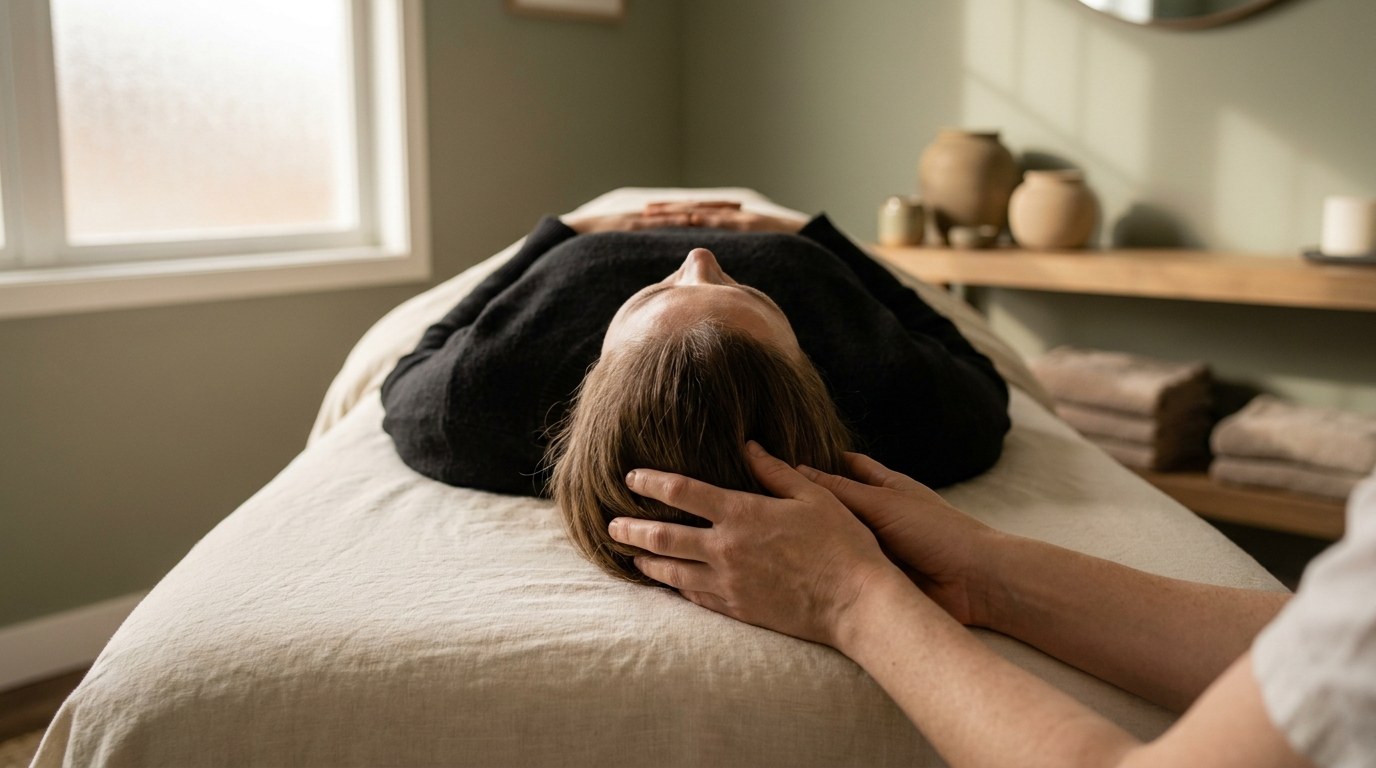
Craniosacral therapy is one of those modalities that's hard to picture until you've felt it. If you're used to massage, with its pressure, movement, and the work of a therapist visibly leaning into tissue, a craniosacral session can be disorienting at first, precisely because so little seems to be happening on the surface. This is a plain-language walkthrough of what a first session actually feels like, from the moment you arrive to how you'll likely feel the next day, so you can arrive knowing what to expect.
Why the first session feels different from any massage you've had
Conventional massage targets muscle and connective tissue with moderate to deep pressure. Craniosacral therapy (CST) works with the subtle rhythms of the tissues surrounding the brain and spinal cord, using gentle, sustained contact, often only a few grams of pressure, less than the weight of a nickel. The intent isn't to work out a knot; it's to help a nervous system that's stuck in a chronic stress or guarding pattern settle and reorganize. That difference in intent is why the experience feels so unlike a massage: there's very little visible movement, long stretches of stillness, and a pace that's slower than most people expect.
What actually happens when you arrive
Your first session begins with a conversation about your health history, any head or spine injuries, surgeries, medications, headache or TMJ patterns, and what brought you in. This intake matters, because it's where I confirm that CST is an appropriate fit for what you're dealing with and screen for anything that would mean waiting or getting medical clearance first.
From there, you'll lie face-up on the table, fully clothed. There's no oil, no draping, and no need to undress. Loose, comfortable clothing is ideal, since you'll be resting still for most of the hour. I'll usually begin with light contact at your feet, sacrum, or the base of your head, and stay with each area for an extended period rather than moving quickly from spot to spot.
What it feels like on the table
The most common first reaction is surprise at how little pressure is involved. From there, sensations vary a lot from person to person. Many people notice a spreading sense of warmth, gentle tingling, or a feeling of the body softening and settling. Some feel subtle releases of tension; others feel a sense of slow internal movement. A great many people simply feel their nervous system downshift. The racing mind quiets, breathing slows, and a deep relaxation takes over. It's common to fall asleep.
Emotional shifts can surface too. Because CST tends to move people into a deeply parasympathetic, safe-feeling state, it's not unusual to feel unexpectedly emotional, and occasionally tears or a wave of relief arrive on their own. This is a normal response, not a sign anything's wrong. If at any point the stillness feels like too much, you can talk, shift, or ask me to change what I'm doing. Nothing about the work requires you to stay silent or hold still through discomfort.
What you might feel afterward
Most people leave a session feeling calm, loose, and noticeably slowed down, and often sleep unusually well that night. Because your system has shifted into such a relaxed state, you may feel a little lightheaded or spacey when you first sit up, so it's worth taking a moment before standing and not rushing back into a busy afternoon if you can help it. A small number of people notice a day of mild fatigue or tenderness as things settle, which typically passes on its own. If you're coming in for a chronic pattern like migraines or TMJ, it's normal not to have a dramatic verdict after one visit; CST tends to be cumulative, which is why a short series is usually more informative than a single session.
When craniosacral therapy isn't the right time
CST is gentle, but gentle doesn't mean it's appropriate in every situation. It is generally avoided during the acute phase right after a significant head injury, a recent skull fracture, or any active or suspected bleeding in or around the brain, because even light changes in fluid dynamics aren't advisable while those situations are still stabilizing. Conditions like a known aneurysm or unstable spinal issues also call for caution and physician oversight. In all of these cases, medical evaluation comes first. CST is a complementary approach that works alongside your physician's care, not a replacement for it. Once you're past the acute stage and cleared by your doctor, the same gentleness that makes CST feel so subtle is often what makes it a good fit for post-concussion and nervous-system recovery.
How many sessions, and what to expect over time
Sessions typically run 45 to 60 minutes. For chronic patterns, a short series of often three to six sessions gives a clearer sense of whether the work is helping before you decide on an ongoing pace. If you're navigating recovery from surgery, illness, or medical treatment that's left your system with little tolerance for anything assertive, CST can be a way to receive supportive bodywork without overwhelming an already-taxed nervous system. You can read more about how this fits into broader recovery care, or simply come in and experience a session for yourself.
Bryan Lindquist, LMT is a clinical massage therapist with more than 20 years of experience, practicing in Salt Lake City at Flow Acupuncture (1204 E South Temple) and at Huntsman Cancer Institute's Wellness & Integrative Health Center. His oncology-informed practice includes craniosacral therapy, manual lymphatic drainage, and orthopedic and post-surgical recovery work.
Frequently Asked Questions
Do I need to undress for craniosacral therapy?
No. You stay fully clothed the whole time, usually lying face-up on the table. Loose, comfortable clothing is ideal since you'll be resting still for most of the session.
Will I actually feel anything if the touch is that light?
Most people do, though it's subtle. Common sensations include warmth, gentle tingling, a sense of the body softening, and sometimes a feeling of movement or release. Many people simply feel their nervous system downshift into deep relaxation, and some fall asleep. Feeling very little is also normal and does not mean the work isn't doing anything.
How is craniosacral therapy different from a massage?
Massage works muscle and connective tissue with moderate to deep pressure. Craniosacral therapy uses very light, sustained contact, often only a few grams of pressure, to help an overloaded nervous system settle. There's little visible movement, and the goal is regulation rather than working out muscle tension.
Is it safe right after a head injury or concussion?
Craniosacral therapy is generally avoided during the acute phase immediately after a head injury, skull fracture, or any bleeding, and is not appropriate for those situations. Once you're past the acute phase and your physician has cleared you, its gentleness is often well suited to post-concussion recovery. Timing should always follow your doctor's guidance.
Curious what a session feels like for you?
Gentle, nervous-system-focused craniosacral care. New clients welcome.
Book a Session