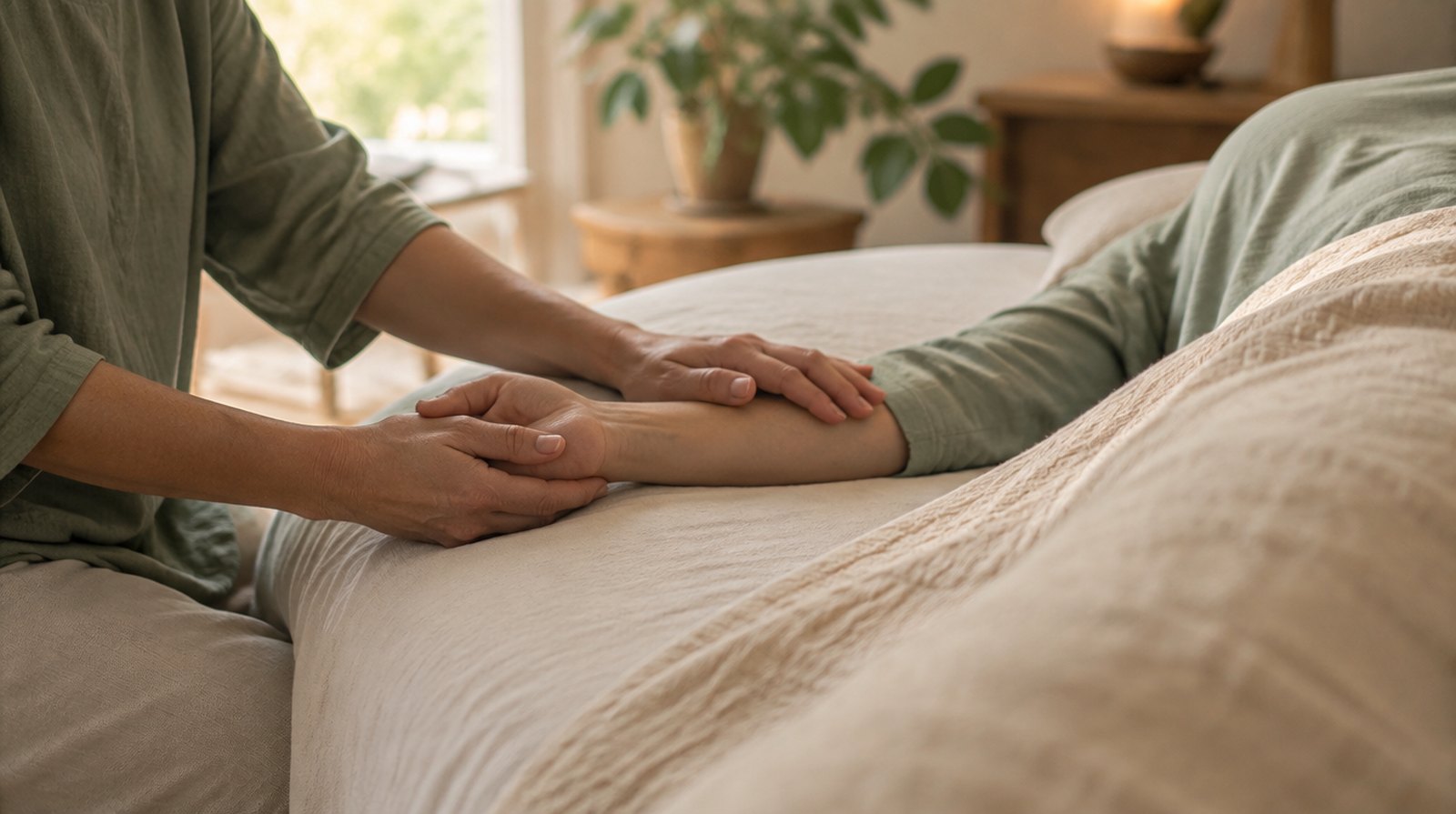
If you've booked a Jin Shin Jyutsu session, or you're just curious what the words even mean, you've probably run into a lot of talk about energy and very little about what actually happens on the table. That gap is fair. The work is quiet, the touch is light, and from the outside it can look like not much is going on. Plenty is going on. It's simply happening at a pace and a depth that don't announce themselves. This is a plain-language guide to what Jin Shin Jyutsu is, what those gentle holds are doing, and what you can expect from a session.
What Jin Shin Jyutsu is, in plain terms
Jin Shin Jyutsu is a centuries-old Japanese art of harmonizing the body through light, sustained touch. The practitioner rests their hands on specific points on your clothed body and holds them, often for several minutes at a time, moving through set sequences. There's no kneading, no stretching, and no manipulation of muscle or joint. You stay dressed, lying comfortably, and the whole session is unhurried from start to finish.
The tradition describes the body as having pathways along which life energy flows, and points where that flow can get stuck. The holds are meant to invite the flow back into balance. You don't have to adopt that framework, or believe anything in particular, for the session to be restful. Many people come simply because it's one of the gentlest, most settling forms of bodywork available, and they leave the philosophy to one side.
The 26 points, and why the holds are "still"
At the center of the practice are what the tradition calls the 26 safety energy locks: specific points mapped along each side of the body, from the head and shoulders down through the hands and feet. Each one has its own name and its own set of associations. In a session, I place my hands on a pair of these points and simply wait, letting the hold do its work rather than pressing or moving.
That stillness is the part people tend to find surprising. We're used to thinking of bodywork as something a therapist does to us, with pressure and movement we can feel. Jin Shin Jyutsu is intentionally the opposite. The light, steady contact is the technique, not a warm-up for something more forceful. Holding a point for several quiet minutes is precisely what gives the nervous system room to downshift, which is hard to rush.
The finger-holds you can actually feel
One of the most approachable parts of the practice happens right in your own hands. In Jin Shin Jyutsu, each finger is associated with a particular emotional and physical theme, and wrapping one hand gently around a finger of the other is a simple self-help hold anyone can try. The tradition connects the thumb with worry, the index finger with fear, the middle finger with anger, the ring finger with grief, and the little finger with the effort of trying too hard.
You don't need to memorize any of that to use it. A lot of people just cradle one finger at a time for a few minutes, breathing slowly, as a way to settle before sleep or steady themselves in a hard moment. Think of it as a small, portable version of the calm a full session aims for. It's a self-care practice rather than a treatment for any condition, and that's exactly the spirit in which it's meant to be used.
What the research suggests, honestly
Jin Shin Jyutsu is a complementary practice, and it's worth being straight about what the evidence does and doesn't show. There's no research indicating that it treats a medical condition or changes the course of a disease, and it should never stand in for the care your medical team provides. What some studies do suggest is that it may help people feel better alongside their treatment. In one study at the University of Kentucky's Markey Cancer Center, 159 cancer patients rated their pain, stress, and nausea before and after Jin Shin Jyutsu sessions, and reported statistically significant improvements, with the biggest drop in stress.
That's a modest but encouraging finding, and it fits what I see in practice: people tend to leave calmer, breathing more easily, and often sleeping better that night. The honest framing is that Jin Shin Jyutsu is supportive care. It's a way to feel more rested and less braced, offered next to, and never instead of, your medical care.
What a session looks like
Your visit starts with a short conversation about how you've been feeling, how you've been sleeping, and anything about your body that's useful for me to know. Then you settle onto the table fully clothed. I'll hold specific points, often in combinations at the hands, feet, and along the torso, staying at each for several minutes while you do nothing but breathe and rest.
Most people find their breathing slows on its own within the first few minutes. Some notice a pulse or a spreading warmth under a hold. Others feel mostly a general settling, and drifting toward sleep is completely normal. Sessions usually run 45 to 60 minutes. You can read more about how I approach this work on the Jin Shin Jyutsu page, and if a still, quiet form of care appeals to you, you might also look at craniosacral therapy, which shares that same gentle spirit.
Who tends to find it helpful
Jin Shin Jyutsu suits people whose bodies have trouble winding down, anyone carrying ongoing stress that hasn't responded to more active approaches, and clients who are medically fragile or simply too tired or sore for conventional massage. Because it asks nothing of the body, it's a comfortable option when more hands-on work would be too much. If you're not sure whether it's the right fit, that's a good thing to talk through together, and we can start gently and see how your body responds.
Bryan Lindquist, LMT is a clinical massage therapist and Reiki Master with more than 20 years of experience, practicing in Salt Lake City at Flow Acupuncture (1204 E South Temple) and at Huntsman Cancer Institute's Wellness & Integrative Health Center. His oncology-informed practice includes Jin Shin Jyutsu, craniosacral therapy, Reiki, manual lymphatic drainage, and orthopedic and post-surgical recovery work.
Frequently Asked Questions
Do the holds involve any pressure or massage?
No. The touch is light and still, with no kneading, stretching, or manipulation of muscle or joint. I rest my hands on specific points and stay there for several minutes at a time. If you're used to deep-tissue work, the stillness can feel surprising at first, and then usually settles into something restful.
Will I feel anything during a Jin Shin Jyutsu session?
Sensations vary from person to person. Some people notice a pulse, a spreading warmth, or a sense of release under a hold. Others feel mostly a general slowing of the breath and a settling in the body. Both are common, and neither one is more correct than the other.
Can I use finger-holds on myself at home?
Yes. Simple self-help finger-holds are one of the most approachable parts of Jin Shin Jyutsu. Wrapping one hand gently around a finger on the other hand for a few minutes is a common way people use it to slow down before sleep or during a stressful stretch. It's a self-care practice, not a treatment for any medical condition.
Is Jin Shin Jyutsu appropriate if I'm medically fragile?
It's often well suited to people who can't tolerate more hands-on work, because there's no manipulation of tissue and the touch is extremely light. It's offered in some integrative cancer programs for that reason. It supports comfort and calm alongside your medical care, and it's never a substitute for the treatment your physicians have planned.
Curious what a quiet, settling session feels like?
Gentle Jin Shin Jyutsu for nervous-system regulation and deep rest. New clients welcome.
Book a Session